
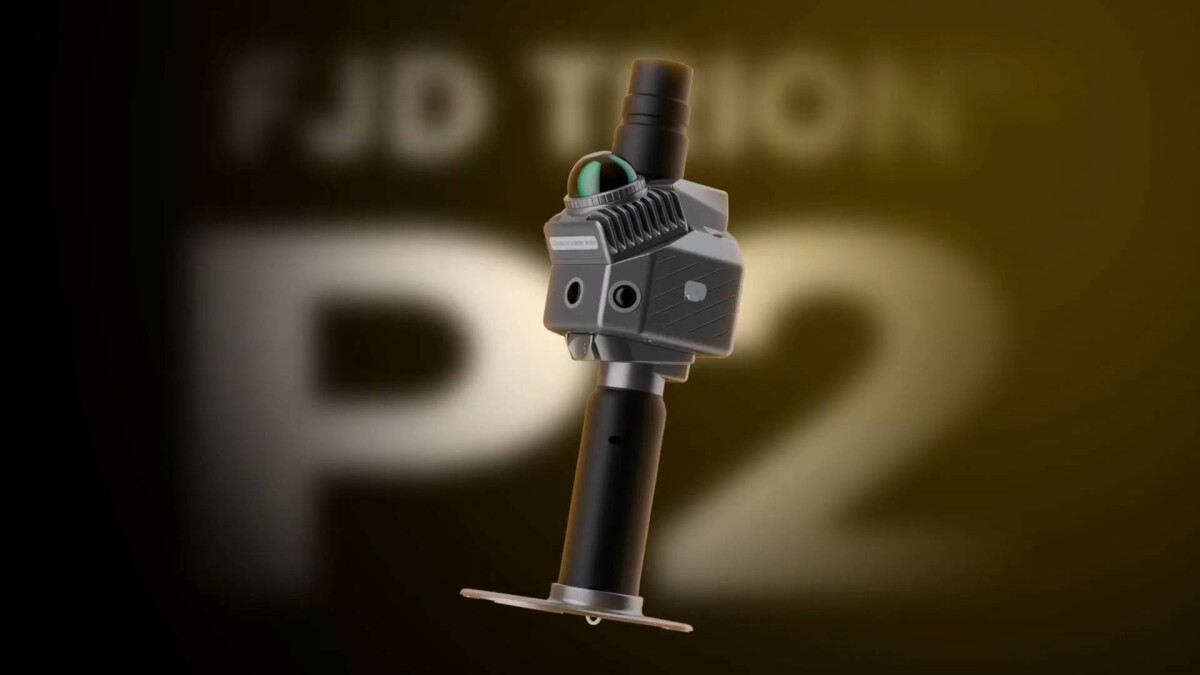
When it comes to reality capture in the field, it's not enough for a device to "scan well." Today, speed, portability, ease of use, and the quality of the entire workflow—from capture to final delivery—also matter. In this scenario, the FJD Trion P1 and the new FJD Trion P2 emerge as two very interesting alternatives for professionals who need to digitize spaces quickly, mobile, and efficiently.
At first glance, both devices share a very attractive promise: portable LiDAR scanning with SLAM technology, real-time visualization, and a much more agile approach than traditional methods for surveying interiors, exteriors, or complex environments. The Trion P1 was introduced by FJDynamics as a compact, accessible, and practical solution, while the Trion P2 aims to evolve the concept with greater accuracy, real-time colorization, and more complete integration with RTK and Trion ecosystem software.
What makes the FJD Trion P1 attractive
The FJD Trion P1 remains a very powerful option for those looking to enter the world of SLAM scanning with a simple and effective workflow. Its datasheet and brochure highlight a relative accuracy of up to 2 cm, a rate of 200,000 points per second, real-time point cloud visualization, and a range of 40 meters at 10% reflectivity or 70 meters at 80%. Additionally, its compact form factor and weight close to 1 kg make it a comfortable tool for mobile workdays.
In practice, this makes the P1 especially attractive for rapid surveys, documentation of spaces, inspections, as-built, indoor scanning, support for 3D modeling, and tasks where mobility weighs as much as precision. Its value lies in the directness of the process: walk, scan, review the cloud on the spot, and then process the information into common formats such as LAS, PCD, PTS, or PLY using Trion Model.
Where the FJD Trion P2 makes a difference
The FJD Trion P2 takes that same approach to a more advanced level. According to information published by Realtek and the FJDynamics hardware manual, the device offers 12 mm accuracy, scanning up to 70 m, real-time preview on a mobile terminal, real-time and post-process point cloud colorization, real-time RTK Fusion, 512 GB internal storage, and IP54.
Beyond the technical specifications, FJDynamics also positions the P2 as a device designed for a more complete field experience: integrated cameras to capture true color, stability supported by Multi-SLAM Fusion, and a workflow that connects capture, processing, and online collaboration via Trion Scan, Trion Model, and Trion Explorer. This makes it especially interesting for users who not only want to measure but also to present visually richer results and reduce intermediate steps in the delivery workflow.
So, which one should you choose?
If your focus is on incorporating a portable SLAM scanner, resolving surveys quickly, and keeping a more contained investment, the FJD Trion P1 remains a very logical alternative. It has a clear, proven, and sufficient proposal for a huge number of jobs where speed and portability are central.
If, on the other hand, you are looking to take a step towards a more robust workflow, with better published accuracy, real-time colorization, integrated RTK support, and a more complete experience between capture, processing, and visualization, the FJD Trion P2 appears as the natural evolution. Simply put: the P1 solves very well; the P2 solves more and with an extra layer of productivity and presentation. This last sentence is a reasonable inference from the published capabilities of both models.
Our recommendation
Choosing between the FJD Trion P1 and the FJD Trion P2 should not depend solely on price or the novelty of the equipment. The best decision comes from understanding what type of project you do most frequently, what level of detail you need to deliver, and how much you value seeing more complete results from the field. For agile surveys and a solid entry into SLAM scanning, the P1 still makes a lot of sense. For those who want a more evolved solution ready for more demanding workflows, the P2 takes the lead.
Because in the end, more than choosing between two scanners, it's about choosing how you want to work in the field: with an efficient and proven solution, or with a newer, more integrated platform ready to take your 3D capture one step further.

